






₹22,495 crore.
That is the amount of financial cyber fraud reported by citizens in India through the National Cyber Crime Reporting Portal and the Citizen Financial Cyber Fraud Reporting and Management System in 2025 alone.
More than 24 lakh financial fraud complaints were reported during the year.
And the numbers tell only one part of the story.
By 30 June 2026, India’s Indian Cyber Crime Coordination Centre (I4C) reported that more than ₹11,158 crore had been saved from being siphoned off, across more than 32.80 lakh complaints through its financial cyber fraud response system. (Press Information Bureau)
The message is clear.
Cyber fraud is no longer simply an IT security problem. It is becoming a business, financial, operational and risk management problem.
The numbers are getting harder to ignore
According to data released by the Ministry of Home Affairs, the amount reported through NCRP for financial cyber fraud has increased significantly over the past few years:
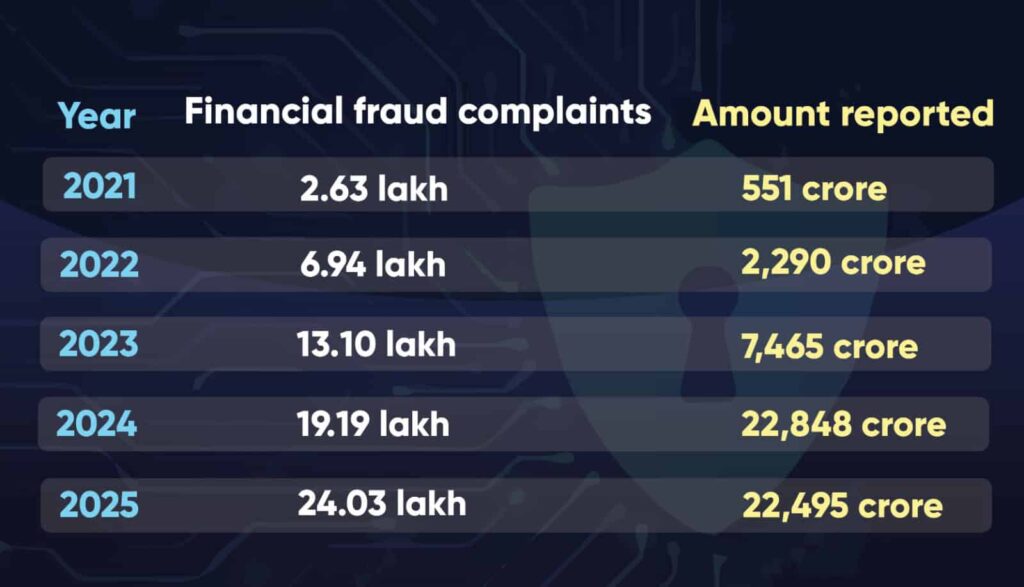
The government notes that the data is dynamic and reflects complaints reported through the NCRP and CFCFRMS ecosystem. (Press Information Bureau)
The 2025 figure therefore should not be interpreted as the total economic cost of cybercrime in India. It represents the amount reported by citizens through this national reporting ecosystem.
That distinction matters.
But even the reported numbers are significant enough to demand attention.
The real challenge is not only fraud. It is speed.
Modern cyber fraud is increasingly designed around speed.
An attacker does not necessarily need to compromise a sophisticated enterprise network.
A convincing phishing message, fake investment platform, impersonation call, malicious application, social engineering campaign or compromised account can be enough to initiate a financial transaction within minutes.
Once money moves through multiple accounts and intermediaries, recovery becomes significantly more difficult.
This is why the time between detection, reporting and response matters.
India’s CFCFRMS was specifically established to enable immediate reporting of financial fraud and help stop funds from being siphoned off. The government has also established the Cyber Fraud Mitigation Centre, bringing together banks, financial intermediaries, payment aggregators, telecom providers, technology intermediaries and law enforcement agencies. (Press Information Bureau)
By June 2026, I4C reported that more than ₹11,158 crore had been saved through this mechanism.
That number represents an important shift.
The response is moving from simply investigating fraud after it happens towards attempting to interrupt fraudulent transactions while they are still in motion. (Press Information Bureau)
But organisations need to make the same shift.
The same principle applies inside enterprises.
For many organisations, cybersecurity still operates in a largely reactive cycle:
Incident → Investigation → Remediation → Reporting
That model has an obvious limitation.
By the time an incident is detected, the attacker may already have obtained access, extracted information, compromised credentials or initiated fraudulent activity.
Organisations need to move towards:
Identify → Assess → Prevent → Monitor → Detect → Respond → Improve
This requires continuous visibility across the organisation’s security and compliance environment.
Cybersecurity cannot be limited to annual assessments
Traditional security programmes often revolve around periodic activities.
→ An annual VAPT.
→ An annual compliance audit.
→ A periodic vendor assessment.
→ A policy review.
→ A penetration test before a major release.
These activities remain important.
But today’s threat environment requires more than point in time assessments.
The question should increasingly become:
What is our security posture today?
Not:
What was our security posture when we conducted the last assessment?
Continuous security monitoring, regular vulnerability assessments, risk based testing, third party risk management, security configuration reviews and continuous compliance monitoring can provide a much more current view of organisational risk.
Third party risk is part of the problem
Organisations are increasingly dependent on vendors, SaaS platforms, cloud providers, technology partners and other third parties.
This creates another challenge.
Your organisation may have strong security controls, but a critical vendor could still introduce risk into your environment.
Traditional third party risk management often relies heavily on questionnaires.
→ Send questionnaire.
→ Wait for response.
→ Review response.
→ Request evidence.
→ Identify gaps.
→ Follow up.
→ Repeat.
For organisations managing hundreds of vendors, this can become difficult to scale.
A more effective approach is to combine vendor inventory, risk tiering, automated assessments, evidence collection, control mapping, issue management and continuous monitoring.
The objective is not simply to complete a vendor questionnaire.
The objective is to understand the risk a third party represents to the business.
Compliance and security need to come together
Cybersecurity and compliance are often managed as separate activities.
They should not be.
An organisation building a strong Information Security Management System around frameworks such as ISO 27001 can create a foundation that supports broader regulatory and compliance requirements.
Controls can then be mapped to applicable requirements across areas such as data protection, financial services regulation, privacy, cloud security and industry specific obligations.
This creates a more sustainable model:
→ Build the control environment once.
→ Monitor it continuously.
→ Map it to multiple requirements.
→ Use evidence and monitoring to demonstrate compliance.
Compliance then becomes more than an annual audit exercise.
It becomes part of the organisation’s ongoing security posture.
The role of AI is changing too
Artificial intelligence is creating another dimension to the cybersecurity challenge.
AI is helping attackers automate reconnaissance, generate convincing messages, accelerate social engineering and scale attacks.
At the same time, organisations are adopting AI tools across software development, customer service, operations and business processes.
This creates new questions:
- Can sensitive data be exposed to AI platforms?
- Can source code be shared with external AI tools?
- Are developers using approved AI services?
- Can AI generated code introduce vulnerabilities?
- Are organisations monitoring AI related risks?
Security programmes therefore need to evolve alongside AI adoption.
AI security cannot be treated as a separate conversation from application security, data security, identity security and governance.
From reactive cybersecurity to continuous cyber resilience
The most important lesson from India’s cyber fraud numbers is not simply that fraud is increasing.
It is that speed matters.
Speed of detection.
Speed of response.
Speed of reporting.
Speed of containment.
Speed of remediation.
And increasingly, speed of understanding risk before it becomes an incident.
The Indian government has strengthened its response infrastructure through I4C, NCRP, CFCFRMS, the Cyber Fraud Mitigation Centre and other initiatives. By June 2026, I4C reported more than ₹11,158 crore in financial fraud had been prevented from being siphoned off. (Press Information Bureau)
Organisations need to adopt the same mindset.
Do not wait for the incident to tell you where the weakness is.
Identify the weakness before the attacker does.
The question businesses should be asking
The question is no longer:
“Are we compliant?”
It should be:
“How continuously are we able to understand, manage and reduce our cyber risk?”
That requires bringing together security testing, vulnerability management, third party risk, cloud security, application security, compliance, risk management and continuous monitoring.
Cybersecurity is moving from a periodic activity to a continuous business function.
And in an environment where billions of rupees can move in minutes, being prepared before the incident is no longer optional.
Sources
Ministry of Home Affairs, Government of India, Indian Cyber Crime Coordination Centre and National Cyber Crime Reporting Portal data. The 2025 financial fraud figures are reported as ₹22,495 crore across 24,02,579 complaints. (Press Information Bureau)
Ministry of Home Affairs, Government of India, July 2026. I4C reported that more than ₹11,158 crore had been saved across more than 32.80 lakh complaints through CFCFRMS up to 30 June 2026. (Press Information Bureau)