CyRAACS SERVICE
Consulting services can provide the expertise and guidance needed to ensure your business is protected from malicious actors. Whether you’re looking to implement a comprehensive security strategy or simply need advice on compliance and data protection, a cybersecurity consultant can provide the support you need.

At CyRAACS, we perform an extensive Risk Assessment to identify the inherent and residual information security risks across the organization. Based on the assessment conducted, we recommend Risk Mitigation measures to ensure the appropriate security controls are in place in line with the organization risk appetite.

Business Continuity planning is essentially a form of insurance. It gives organizations the comfort of knowing that, even if disaster strikes, the damage won’t be overwhelming.
Having an effective Business Continuity Management ensures that organizations can continue to provide an acceptable service in the event of a disaster, helping them preserve their reputation and keep revenue coming in. In the event that its key management resources are compromised, it is critical for an organization to be proactive and create a viable plan of countermeasures.
CyRAACS’s business continuity professionals provide consultancy help in identifying risks arising from third party vendor networks, managing them effectively, and planning how you can operate, improving your organizational resilience.

An Information Security Maturity Model provides a path forward and enables the organization to periodically assess where it is along that path. Our unique qualitative and quantitative assessment model is adapted from the CMMI rating scale. CyRAACS’s Maturity Model Assessment framework helps to understand the organization’s risk exposure, and the maturity of the current information security program and identify areas for improvement, we also create benchmarks against other organizations and validate that security investments have improved security posture. We also provide a roadmap with opportunities in the areas of technology, process, and capabilities for information security.
For today’s way of the data treatment, it is an easy target to expose as organizations across the world are looking at the increasing amounts of data to deal with every day, this could be through e-mails, files, transactions, etc. Hence organizations urgently need to understand what their sensitive data is and where they are so that they can deploy appropriate controls to protect it. Data Flow Analysis (DFA) is the first step toward identifying sensitive data and implementing appropriate security controls for data protection.
CyRAACS’s DFA framework covers all the stages of the data lifecycle right from data acquisition to retirement. It helps to capture an accurate picture of the data flow at various stages within the organization. The output from DFA can act as key inputs to a Digital Rights Management (DRM) or Data Leakage Prevention (DLP) tool implementation, should an organization wish to implement those tools.

Build your future with us.
In an era where regulatory requirements are multiplying faster than cybersecurity budgets, forward-thinking CISOs are discovering that outsourcing compliance management isn’t just a cost-saving strategy, it’s a competitive advantage that
In today’s fast-moving business landscape, the greatest threats often lay beyond the balance sheet. Non-financial risks ranging from reputational damage and regulatory missteps to supply-chain disruptions and cyber incidents no
The Hidden Cost of Playing Catch-Up In boardrooms across banking, healthcare, and emerging enterprises, forward-thinking leaders are asking: “How can we turn compliance into a competitive advantage?” This shift from
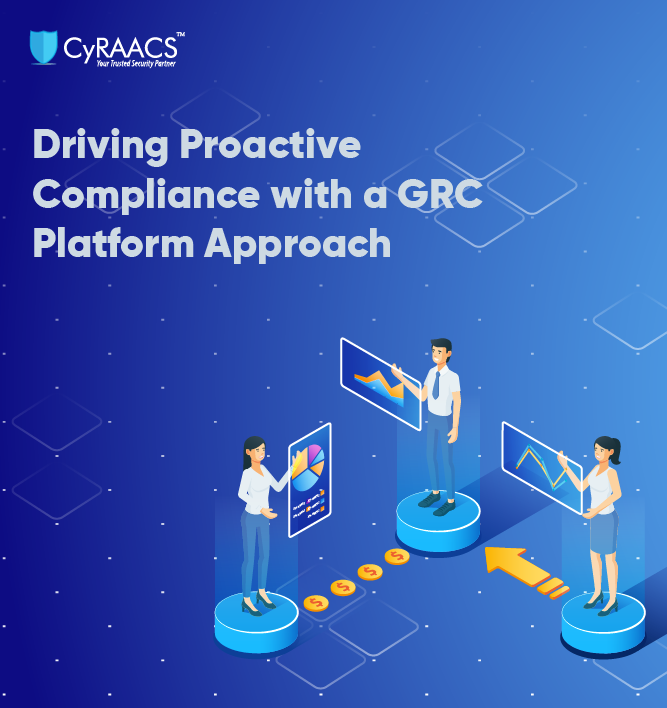
In today’s volatile and fast-evolving regulatory landscape, Governance, Risk, and Compliance (GRC) can no longer be managed through fragmented spreadsheets, disjointed tools, or over-engineered platforms that require a steep learning
Deploying a Governance, Risk, and Compliance (GRC) tool is a major milestone—but it’s not always smooth sailing. While the promise of automation, visibility, and standardization is compelling, many organizations struggle
Choosing the right Governance, Risk, and Compliance (GRC) tool is a strategic decision. It impactss not only your organization’s ability to meet regulatory requirements but also how effectively risks are
Banks, insurers, and Non-Banking Financial Companies (NBFCs) across India stand at the epicentre of a perfect regulatory storm. With the Reserve Bank of India’s Master Direction on Information Technology Governance,
Cyber resilience isn’t just about responding to threats—it’s about being prepared, proactive, and aligned across governance, risk, and compliance (GRC) functions. While many organizations have individual GRC processes in place,
In today’s ever growing technology and compliance-driven world, organizations face a unique challenge: their governance risk and compliance (GRC) functions though vital for operations operate in silos. The compliances and
As organizations expand and regulations like ISO 27001, SOC 2, NIST, PCI DSS, DPDPA, GDPR, and RBI evolve, manual Governance, Risk, and Compliance (GRC) management becomes impractical. The traditional approach
In an increasingly regulated and digitally connected world, compliance is no longer optional it’s essential. Organizations are expected to demonstrate security, accountability, and governance across a wide array of standards
Managing the security posture across multiple organizations emphasizes a fundamental necessity: policies must evolve beyond static compliance documents to become facilitators for secure innovation and sustainable growth. Organizations that embed
In today’s interconnected world, data privacy isn’t just a legal obligation; it’s a fundamental responsibility. Organizations handle vast amounts of personal information, ranging from financial details to browsing habits, and
Cyber threats are evolving at lightning speed, and staying one step ahead requires more than just reacting after the fact. Today’s threat landscape demands a proactive, well-structured strategy to identify,
Large Language Models (LLMs) have revolutionized the way we interact with technology, enabling natural language conversations, code generation, content creation, and more. These models, built on advanced deep learning techniques,
1. Definingan Audit An Information Security (IS) Audit is a methodical, impartial examination of an organization’s security ecosystem. Its purpose is to verify that policies, procedures, technical defenses, and operational