




For many organizations, the compliance cycle is predictable.
Prepare for the audit. Gather evidence. Address findings. Pass the assessment. Repeat next year.
While this approach may satisfy regulatory requirements, it doesn’t necessarily strengthen your security posture.
Here’s why.
Your audit reflects your organization’s state on the day it was conducted. The moment the audit concludes, your IT environment continues to evolve. New users are onboarded, cloud configurations change, applications are updated, vendors gain access, and cyber threats continue to emerge.
The question is no longer: “Did we pass the audit?”
It is: “Are we still compliant today?”
That’s where continuous monitoring becomes essential.
The Limitations of Traditional Audits
Cybersecurity audits remain an important part of any Governance, Risk, and Compliance (GRC) program. They help organizations:
- Demonstrate regulatory compliance.
- Validate the effectiveness of security controls.
- Identify control gaps and areas for improvement.
- Build stakeholder and regulator confidence.
However, audits are point-in-time assessments. They tell you what your environment looked like during the assessment, not what changed the next day.
Consider these scenarios:
- A privileged account is granted excessive access after the audit.
- A cloud storage bucket becomes publicly accessible due to a configuration change.
- A critical security patch is delayed.
- A third-party vendor introduces a new risk.
- A security control is unintentionally disabled.
Your audit report won’t capture these changes; continuous monitoring will.
Continuous Monitoring: Turning Compliance into a Daily Practice
Continuous monitoring is the ongoing process of evaluating your organization’s security and compliance posture in real time.
Instead of waiting months to identify issues, organizations gain continuous visibility into their control environment and can respond before risks become audit findings or worse, security incidents.
An effective continuous monitoring program includes:
- Continuous control validation
- Configuration and policy monitoring
- Automated evidence collection
- Compliance dashboarding and reporting
- Risk tracking and remediation
- Third-party risk oversight
- Security posture monitoring
The objective is not just to maintain compliance. It is to maintain confidence.
Why Continuous Monitoring Matters
Organizations today operate in highly dynamic environments.
Cloud adoption, hybrid work, AI, digital transformation, and increasing regulatory expectations have significantly expanded the attack surface.
At the same time, regulations increasingly expect organizations to demonstrate that controls are consistently effective, not just compliant during an annual review.
Continuous monitoring helps organizations:
- Detect compliance drift before it becomes a finding.
- Reduce manual effort during audits.
- Maintain real-time visibility into critical controls.
- Respond faster to security incidents.
- Strengthen governance and accountability.
- Improve operational resilience.
In short, it shifts compliance from a reactive exercise to a proactive business capability.
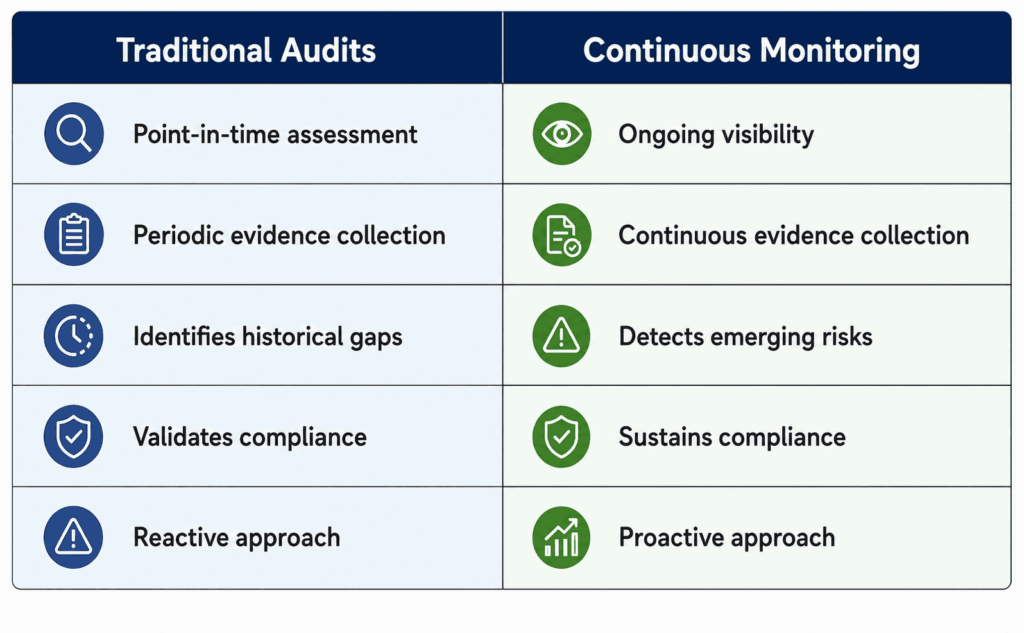
Organizations achieve the greatest value when audits validate what continuous monitoring has already helped maintain.
The Business Benefits Go Beyond Compliance
Continuous monitoring isn’t just about satisfying regulators.
It also helps organizations:
- Improve decision-making with real-time insights.
- Reduce audit preparation time and associated costs.
- Strengthen customer and stakeholder trust.
- Prioritize remediation based on actual risk.
- Support business continuity and operational resilience.
For leadership teams, it provides confidence that governance is not limited to audit season; it is embedded into everyday operations
How CyRAACS Enables Continuous Compliance
At CyRAACS, we help organizations move beyond traditional compliance management.
Our Governance, Risk, and Compliance (GRC) solutions and Compliance Management as a Service (CMaaS) enable organizations to continuously monitor their compliance posture, automate evidence collection, track control effectiveness, manage risks, and stay prepared for audits throughout the year.
Whether you’re aligning with ISO 27001, SOC 2, RBI, SEBI, DPDPA, PCI DSS, HIPAA, or other regulatory frameworks, our experts work alongside your teams to simplify compliance while strengthening cyber resilience.
Instead of preparing for compliance once a year, organizations can build a culture of continuous assurance.
From Audit Ready to Always Ready
Passing an audit demonstrates that your organization met the required controls at a specific point in time. Continuous monitoring demonstrates that those controls continue to work every day.
In today’s threat landscape, organizations need more than successful audits. They need continuous visibility, continuous assurance, and continuous confidence.
Ready to Build a Continuous Compliance Program?
CyRAACS helps organizations transform compliance from a periodic obligation into an ongoing business advantage. By combining expert advisory services, technology-driven GRC solutions, and continuous monitoring capabilities, we help you stay compliant, reduce cyber risk, and remain audit-ready throughout the year.
Contact CyRAACS today to discover how continuous monitoring can strengthen your compliance program and improve your organization’s cyber resilience.