






In today’s hyper-connected business environment, it’s no longer enough to think of cybersecurity in purely technical terms. Executives and security leaders are increasingly focusing on cyber risk management – a broader, strategic approach that goes beyond deploying firewalls and anti-virus software. While cybersecurity and cyber risk management are related, they are not interchangeable. Understanding the distinction is critical for C-level executives and InfoSec managers who must align security initiatives with business objectives and regulatory obligations. This blog will clarify these concepts, outline the key processes and benefits of a risk-driven approach, and explain why guiding cybersecurity with robust risk management practices leads to more effective outcomes.
The 2 terms frequently used in this context are “cybersecurity” and “cyber risk management.” While often used interchangeably, they represent different approaches to protecting digital assets. This blog post delves into their distinctions and explains why understanding both is crucial for effective protection of digital assets.
1. Defining Cyber Risk Management vs. Cybersecurity
Conceptual Differences
- Cybersecurity focuses on protecting systems, networks, and data from digital threats. It involves technical controls like firewalls, antivirus, encryption, and access management to prevent breaches and service disruptions.
- ·Cyber Risk Management is a strategic process that assesses and addresses cyber threats in line with business objectives. It prioritizes risks based on asset value and potential impact, guiding decisions on mitigation, transfer, or acceptance.
- In essence, cybersecurity is a subset of cyber risk management. While cybersecurity handles day-to-day protection, cyber risk management provides the broader framework for making informed, business-aligned security decisions .As one of the prominent Authors Mike Chapple in his CISSP Source material succinctly puts it:
“Cybersecurity is managing risks to the confidentiality, integrity, and availability of information assets by applying Organizational, People, Operational and Technical Controls”.
- In other words, cybersecurity is about tactical security controls, whereas cyber risk management is about strategic risk-based decisions on those controls.
Practical Differences
In practice, these differences manifest in several ways:
| Cybersecurity | Cyber Risk Management |
|---|---|
| Tactical and operational | Strategic and business-oriented |
| Focuses on technical controls | Balances technical controls with business needs |
| Aims to prevent all breaches | Accepts some level of risk as inevitable |
| Success measured by incidents prevented | Success measured by optimized risk posture |
| Led by technical teams | Involves cross-functional stakeholders |
| Criterion | Cybersecurity | Cyber Risk Management |
|---|---|---|
| Primary Focus | Protecting IT systems, networks, and data from unauthorized access or attacks. Emphasizes technical safeguards against threats (e.g. malware, hacking). | Identifying and managing risks that could impact business objectives. Emphasizes risk assessment, prioritization, and decision-making about how to handle cyber threats. |
| Scope | Narrower scope – deals mainly with digital security of information systems and the cyber threat landscape (hackers, viruses, etc.). Often confined to IT department responsibilities. | Broader scope – encompasses all factors that could lead to information loss or disruption, including technology failures, human error, process gaps, and third-party risks. Involves enterprise-wide participation (IT, business, compliance, execs). |
| Approach | Largely reactive and tactical: implements controls to prevent or respond to known threats. Focused on immediate protection of assets (“lock the doors and watch for intruders”). | Proactive and strategic: anticipates potential risks and prioritizes responses. Integrates with strategic planning (“which risks do we accept, mitigate, or transfer given our goals?”). It’s an ongoing management process with feedback loops. |
| Activities & Tools | Activities include system hardening, network monitoring, incident response, threat intelligence, vuln ([What is Cyber Risk Management? | Activities include risk assessments, maintaining a risk register, risk scenario analysis, control evaluation, and oversight of remediation plans. Uses tools like GRC (Governance, Risk & Compliance) platforms, risk dashboards, heat maps, and risk scoring models. Often aligned with frameworks (NIST RMF, ISO 27001) for structure. |
| Decision-Making | Operational decisions made by security teams (e.g. which systems to patch first, how to configure a firewall). Tends to lack formal authority to decide on business trade-offs – does not decide which risks to accept, it just attempts to reduce all technical risks it sees. | Risk treatment decisions made by management (often with CISO input) weighing business impact and risk appetite. For example, leadership might decide to accept a risk or invest in cyber insurance – decisions beyond the purview of a technical team. Cyber risk management guides where to focus cybersecurity efforts and budget. |
| Metrics of Success | Measured by reduction in incidents or technical indicators: e.g. number of attacks blocked, time to detect/respond to breaches, % systems patched, compliance pass rates. Often technical KPIs. | Measured by reduction of risk exposure and informed risk-taking: e.g. risk heat map shows fewer high risks over time, risk assessment scores improving, alignment with risk tolerance. Also tracked via business impact metrics (less downtime, fewer loss events) and audit/assurance reports. |
| Alignment with Business | Historically sometimes siloed – security for security’s sake. May implement best-practice controls universally, sometimes without full regard to business priority (which can lead to over-engineering in low-risk areas or controls that hinder business efficiency). | Explicitly aligned to business strategy and objectives. Ensures that security efforts are directed at protecting what matters most to the business and enabling business goals safely. Communicates in business terms (financial impact, operational risk), making it relevant at the board level. |
| Examples of Concerns | “How do we keep threat actors out of our network?” “Did we patch all servers for the latest vulnerability?” “Are our antivirus and firewalls up to date?” “How quickly can we detect and stop a breach?” | What would be the business impact if our customer databasewas breached?” “What is the likelihood of a major outage and are we prepared?” “Are we investing in the right areas ofsecurity?” “How do our security risks compare to other business risks, and whatlevel of risk are we willing to accept?” |
As shown in the table above, cybersecurity is a foundational element – it provides the tools and practices to secure systems – but cyber risk management is the guiding framework that determines how, where, and to what extent those tools are applied. Cybersecurity tends to be more technical and granular, while cyber risk management is more holistic and high-level. Both are vital, but they operate at different planes: one at the operational defence level, and the other at the governance and strategy level.
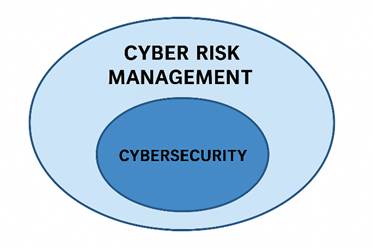
Cyber risk management can be thought of as a superset that encompasses areas cybersecurity alone may not cover. It provides a holistic approach to managing cyber risks across the enterprise. This broader perspective is one of the most important distinctions for executives to grasp, as it shows how a risk-managed program extends the influence of cybersecurity into governance, compliance, and business continuity.
Cyber risk management spans multiple domains beyond just technical cybersecurity measures – including the protection of data, ensuring regulatory compliance, and maintaining business continuity. This broader scope highlights how cyber risk management serves as a superset of traditional cybersecurity, aligning security efforts with business objectives and risk considerations in various areas.
2. What are the Processes in Cyber Risk Management?
Cyber risk management follows a structured process cycle that typically includes:
- Risk Identification: Discovering and documenting potential risks to information assets, typically through asset discovery and inventory, risk assessment, threat modelling, and vulnerability assessments.
- Risk Assessment: Evaluating the likelihood and potential impact of identified risks, often using quantitative methods (like FAIR methodology) or qualitative scales.
- Risk Analysis: Determining the relationship between identified risks and their potential effects on business objectives, examining risk interdependencies and root causes.
- Risk Response Planning: Developing strategies to address risks through:
- Risk Mitigation: Implementing controls to reduce risk
- Risk Transfer: Sharing risk through insurance or third parties
- Risk Acceptance: Formally acknowledging and accepting residual risk
- Risk Avoidance: Eliminating activities that create unacceptable risk
- Risk Treatment Implementation: Executing the chosen risk response strategies, including deploying technical controls, procedural changes, or policy updates.
- Risk Monitoring and Review: Continuously evaluating the effectiveness of risk treatments and identifying emerging risks.
3. How is Cyber Risk Management Important?
Cyber risk management has become essential to modern organizations for several key reasons:
1. Strategic Alignment
Risk management ensures security efforts align with business objectives. Rather than implementing security for security’s sake, risk-based approaches focus resources where they provide the most business value.
2. Regulatory Compliance
Many regulations (GDPR, HIPAA, SOX, NYDFS, etc.) now explicitly require risk assessments and management processes, making formal risk management programs avlegal necessity.
3. Resource Optimization
With limited cybersecurity budgets and talent, risk-based approaches help organizationsvallocate resources to address the most significant threats first.
4. Executive Communication
Risk management provides a business-focused language that bridges the gap between technical security teams and executive leadership, facilitating better decision-making.
5. Adaptability
As threats evolve rapidly, risk management provides a framework for continuously evaluating and adjusting security postures rather than relying on static security approaches. Automated risk management systems enhance these benefits by providing real-time risk dashboards that can clearly demonstrate to executives and board members how security investments directly reduce organizational risk. These tools can simulate the impact of different security investments, helping to justify budget requests with clear risk reduction metrics.
4. Risk-Based Decision Making: Benefits for Organizations
Risk-based decision-making enables smarter security investments, clearer executive buy-in, and stronger outcomes. Key benefits include:
- Resource Optimization: Focuses efforts on high-impact risks, avoiding overspending on low-priority areas.
- Strategic Clarity: Links security actions to business risk, making decisions easier to justify and prioritize.
- Fewer Crises: Proactively addresses top threats, reducing surprise incidents and enabling faster recovery.
- Cultural Alignment: Encourages cross-functional ownership of cyber risk, strengthening security culture.
- Continuous Improvement: Enables tracking of risk reduction over time, shifting focus from activity to outcomes.
5. What Does Cybersecurity Risk Management Bring That Cybersecurity Does Not?
As a superset of cybersecurity, risk management introduces several critical elements:
- Business Context Integration
- While cybersecurity may identify vulnerabilities, risk management determines their importance based on business context. For example, a vulnerability in an isolated test system has different risk implications than the same vulnerability in a customer-facing payment system.
- Formalized Risk Acceptance
o Risk management establishes processes for formally accepting certain risks when the cost of mitigation exceeds the potential loss. This creates accountability and transparency for security decisions.
- Quantitative Analysis
o Advanced risk management often incorporates quantitative methods like Monte Carlo simulations, expected loss calculations, and return on security investment analysis—moving beyond the qualitative assessments common in traditional cybersecurity.
- Third-Party Risk Oversight
o Risk management extends security considerations to the entire supply chain and partner ecosystem, addressing risks that extend beyond an organization’s direct control.
- Business Continuity Integration
o Risk management connects cybersecurity with disaster recovery and business continuity planning, focusing not just on preventing incidents but on maintaining operations when they occur.
- Security Portfolio Management
o Risk management provides frameworks for balancing investments across different security domains based on their risk reduction potential, similar to financial portfolio management.
o Automated risk management tools bring these capabilities to life through features like:
- Quantitative risk modeling using frameworks like FAIR
- Business impact simulations for different attack scenarios
- Third-party risk management portals
- Integration with business continuity management systems
- Unified Controls Framework mapping that shows how controls address multiple risks and compliance requirements simultaneously
5. Executive Perspectives: When to Prioritize Risk Management Over Security Alone
From a leadership standpoint, one might ask: when should we emphasize cyber risk management activities instead of just pumping resources into more cybersecurity tools and operations?
The answer, increasingly, is always – or at least, before you make major security investments or strategic decisions. Here are some executive-level considerations on when and why to prioritize risk management:
- Business Alignment: Risk is the language of executives—it supports decisions based on trade-offs, ROI, and uncertainty, just like finance or operations.
- Strategic Insight: Risk management enables smarter choices during digital transformation, M&A, product launches, and tech investments by showing how security ties to business impact.
- Governance Accountability: Boards and executives have a fiduciary duty to oversee enterprise risk, including cyber risk. A risk-focused approach helps fulfill that responsibility.
- Appropriate Abstraction: Executives don’t need to know how firewalls work. They need to know the top risks, their potential impact, and what’s being done about them.
- Efficient Budgeting: Instead of reacting to headlines, leaders can fund controls that mitigate high-priority risks, improving ROI and reducing exposure over time.
- Cultural Impact: By asking risk-centric questions—like “What are our top cyber risks?” or “Are we within our risk appetite?”—leaders drive awareness, accountability, and cross-functional collaboration.
- Technology-Enabled Decisions: Executive dashboards, risk heatmaps, and scenario modelling can be used to translate complex cyber data into actionable insights. They integrate with enterprise risk frameworks, ensuring cyber risk is viewed in the broader business context.
6. Final Thoughts/ TL;DR
Cybersecurity defends against threats; cyber risk management guides which threats matter most. By treating cybersecurity as a subset of broader risk strategy, organizations align protection with business goals, optimize resources, and enable informed decisions.
The future isn’t security vs. risk—it’s security through risk. Executives who lead with this mindset build resilience, accountability, and strategic advantage.