


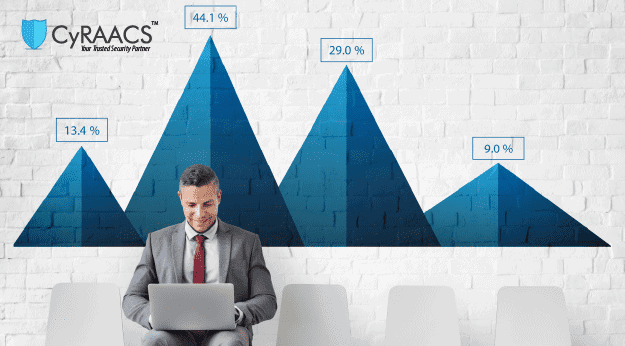



Phishing remains the most common attack entry point in 2026, accounting for roughly 31% of known breach vectors. That single statistic reflects something security teams know well: the types of risk in cybersecurity are not static, and they are not evenly distributed. Different organizations face different risk profiles depending on their infrastructure, the data they hold, how they use cloud services, and who has access to their systems.
Cybersecurity risk is not the same as a cybersecurity threat. A threat is a potential source of harm. A risk is the likelihood that the threat materializes combined with the impact it would cause. Understanding both dimensions – what threatens your environment and what factors make that threat likely to succeed – is what a useful risk picture looks like.
This guide covers the main categories of cybersecurity risk, with practical context for each, and examines the assessment methods organizations use to prioritize and act on them.
Common Cybersecurity Threats and How They Translate to Risk
Common cybersecurity threats include phishing, ransomware, credential theft, supply chain attacks, and exploitation of unpatched vulnerabilities. Each one is a mechanism. The risk it creates depends on what controls are in place to stop it and what damage it would cause if it got through.
Phishing works because it targets people, not systems. A well-crafted email can bypass technical controls entirely. Ransomware has shifted from broad spray attacks to targeted campaigns against organizations with known recovery gaps. Credential theft – accounting for 21% of breaches according to recent data – typically exploits weak multi-factor authentication setups or reused passwords.
Supply chain attacks, best illustrated by the SolarWinds incident, exploit the trust organizations extend to their vendors and software providers. A single compromise of a widely trusted tool can cascade across hundreds of downstream organizations simultaneously.
These common cybersecurity threats rarely succeed in isolation. They exploit combinations of technical weaknesses, human behavior gaps, and governance failures – which is why treating them as discrete technical problems, rather than risk categories to be assessed and managed, misses the point.
Network Security Risks: Where Exposure Begins
Network security risks include unauthorized access, lateral movement, unencrypted traffic, misconfigured firewalls, and DDoS attacks. They represent the infrastructure layer where most initial compromises take hold.
Misconfiguration is a consistent contributor. A firewall rule that is too permissive, an exposed administrative interface, or a segment that should be isolated but is not – these create pathways that attackers find and exploit. The challenge is that networks grow in complexity faster than configuration reviews keep pace.
Lateral movement is particularly dangerous. Once an attacker establishes a foothold in a network, the absence of internal segmentation lets them move freely from system to system, escalating privileges and mapping the environment before anyone detects the intrusion. This is why detection and response capabilities matter as much as perimeter controls.
Network security risks also extend to remote access infrastructure. The widespread use of VPNs, RDP, and cloud management consoles creates additional entry points that require the same level of hardening as the core network. Organizations that secured their perimeter but left remote access infrastructure weakly protected learned this during the wave of credential-based attacks in recent years.
Data Breach Risk Factors: What Makes Organizations Vulnerable
The average cost of a data breach in the US reached $5.18 million in early 2025. That figure includes detection costs, containment, notification, regulatory penalties, and reputational fallout. Understanding the data breach risk factors that drive this exposure is what gives organizations a practical remediation target.
The most consistent data breach risk factors include weak access controls, unpatched systems, excessive data retention, poor encryption practices, and inadequate monitoring. Credential compromise sits at the top – it accounts for a significant share of breaches because it bypasses technical controls entirely by impersonating legitimate users.
Excessive data retention amplifies risk considerably. Organizations that hold personal or sensitive data beyond its useful life create unnecessary exposure. Every dataset that persists is a dataset that could be breached. Data minimization practices – collecting only what is needed and deleting it when no longer required – directly reduce breach impact even when a compromise occurs.
Third-party access is another consistent risk factor. Vendors, contractors, and service providers often hold standing access to systems or data. The 2025 Allianz Life breach illustrates this clearly – the compromise occurred through a third-party cloud CRM platform, not through the organization’s own systems directly.
Insider Threats in Cybersecurity: The Risk from Within
Insider threats in cybersecurity are often underweighted relative to external attacks. Data from the 2024 Insider Threat Report found that 83% of organizations reported at least one insider attack in the previous year. The numbers are consistent with what security teams observe in practice.
Insider threats fall into two categories. Malicious insiders act with intent – they steal data, sabotage systems, or exfiltrate intellectual property, sometimes for personal gain and sometimes on behalf of a competitor. The 2022 Yahoo case is instructive: a research scientist exploited privileged access after accepting a job offer from a competitor, taking proprietary data before leaving.
Negligent insiders cause more incidents by volume. These are employees who click phishing links, misconfigure systems, share credentials, or transfer sensitive files to personal devices without malicious intent. The outcome can be the same as a deliberate attack.
Insider threats in cybersecurity are particularly hard to detect because legitimate credentials are being used. Behavioral analytics, least-privilege access controls, and disciplined offboarding procedures are the primary controls. Monitoring alone is not sufficient – the access model needs to limit what any single user can reach, regardless of intent.
Cloud Security Risks Examples Organizations Face
Cloud security risks examples encountered in practice include misconfigured storage buckets, excessive identity permissions, insecure API connections, insufficient logging, and zero-day exploitation of cloud-native services.
Misconfigured storage is among the most consistently reported cloud exposures. A publicly accessible S3 bucket, a storage account without access controls, or a database with a default configuration can expose significant volumes of sensitive data before the organization even knows it exists. These are not sophisticated attacks – they are opportunistic findings from automated scanning tools.
Identity and access management failures are the second major category. Cloud environments give users and services permissions that accumulate over time. An over-privileged service account compromised by an attacker gives lateral movement across cloud resources that would otherwise require complex exploitation to reach.
The cloud security risks examples that surface in AI and cloud platform deployments also include insecure agent permissions – a risk area that has expanded as organizations deploy AI-enabled workflows. Where AI agents have broad access to cloud APIs or data sources, the blast radius of a compromise extends significantly beyond what traditional access models anticipated. For organizations deploying AI systems, an AI security assessment specifically addresses these emerging risks.
Cyber Risk Assessment Methods: Choosing the Right Approach
Cyber risk assessment methods fall into three primary categories: qualitative, quantitative, and hybrid. Each serves a different purpose, and the right choice depends on the decision being made.
Qualitative assessments rate risks as low, medium, or high based on likelihood and impact judgments. They are faster to conduct and require less data, making them useful for initial risk identification and prioritization. Most organizations start here. The NIST SP 800-30 guide for risk assessments provides a structured qualitative methodology that is widely applied.
Quantitative methods assign numerical values – financial figures, probability percentages – to risks. The FAIR (Factor Analysis of Information Risk) model is the most recognized quantitative framework for cybersecurity. It translates risk into monetary terms, which makes it directly useful for investment decisions and board-level reporting. The trade-off is that quantitative analysis requires more data and more time to execute.
Hybrid cyber risk assessment methods combine both approaches. Qualitative analysis identifies and prioritizes the risk landscape. Quantitative analysis then provides depth on the highest-priority items. Most mature programmes operate this way.
For organizations using compliance frameworks, the NIST Cybersecurity Framework 2.0 and ISO 27001 both incorporate risk assessment as a foundational requirement. The assessment method chosen needs to be repeatable and defensible, not just practical for the first cycle.
How CyRAACS Helps Manage Cybersecurity Risk
CyRAACS is a CERT-In empanelled and CREST accredited cybersecurity and GRC consulting firm. Our work spans the full range of cybersecurity risk – from technical assessments that identify network and application vulnerabilities to governance and compliance programmes that give organizations a structured way to manage risk over time.
For organizations that need a technical view of their exposure, our VAPT services test network security, application controls, and cloud configurations against real attack methods. Our technical security services go beyond automated scanning to provide assessment depth on the controls that matter most for your environment.
For cloud and AI-specific risks, our AI security assessment addresses the growing exposure from AI-enabled applications, insecure agent configurations, and model-level vulnerabilities. Organizations managing vendor risk alongside internal controls can integrate our TPRM services to cover supply chain exposure systematically.
For organizations that need a structured risk management programme rather than point assessments, our GRC services and compliance management platform, COMPASS, provide ongoing risk visibility and remediation tracking. Contact us to discuss your organization’s risk picture.
FAQs About Types of Risk in Cybersecurity
What is the difference between a cybersecurity threat and a cybersecurity risk?
A threat can be defined as a possible cause of harm – for example, a phishing campaign, a ransomware group, or an unpatched vulnerability. Risk is calculated by multiplying the likelihood of the threat by the impact that would result if it actually materialised. The purpose of a risk assessment is to measure both of these aspects so that organisations can decide which issues to tackle first.
What are the most common information security risks examples for enterprises?
The most consistent information security risks examples for enterprise organizations include credential compromise, unpatched software vulnerabilities, misconfigured cloud infrastructure, third-party access failures, and inadequate incident detection. These appear across sectors regardless of organization size.
How do insider threats differ from external cyber threats?
External threats come from outside the organization and have to find a way in, whereas insider threats already have access and take advantage of the credentials they are entitled to and the authorized entry points which makes it much more difficult to detect them. The most effective way of reducing such threats is to put in place controls that restrict what each user can access, no matter how much trust is placed in them.
What is a practical first step for a cyber risk assessment?
Begin with a qualitative gap assessment using a well-recognized framework – NIST CSF 2.0 or ISO 27001 are the most commonly employed ones. This step involves comparing your existing controls with the established requirements, spotting any gaps, and providing a prioritized list of actions. On this basis, more focused technical assessments can then be carried out for the areas of highest risk that the gap assessment has identified.
Do cloud environments require a different risk assessment approach?
It is not a completely different approach but one that places a different emphasis on various technical aspects. A cloud risk assessment should include identity and access management, storage configurations, API security, the completeness of logging and monitoring, and the definition of shared responsibility boundaries – areas in which standard on-premise assessments usually have limited visibility.
Conclusion
The types of risk in cybersecurity span network, data, insider, and cloud categories – each with distinct characteristics and distinct controls. Understanding them clearly is what allows organizations to allocate security investment where it reduces actual exposure rather than just checking a compliance box. CyRAACS combines technical security assessment with structured GRC programme management to help organizations build a risk picture that is grounded in their actual environment. Reach out to discuss your risk assessment requirements and identify the right starting point for your programme.